
Functional beverages are no longer confined to gym shaker cups or the natural grocery aisle. With the global functional drink sector crossing $160 billion, guests increasingly expect everyday beverages to do more than quench thirst: they want protein, gut support, sustained energy, and cognitive recovery.
For quick-service and fast-casual operators, this shift brings a clear dilemma. When macro-chains spin up dedicated beverage concepts and direct-to-consumer supplement brands capture market attention, how does a focused beverage franchise stand out—and more importantly, drive consistent unit-level profitability?
On a recent episode of the Fast Casual Nation podcast, Juice It Up CEO Susan Taylor and Co-Owner Chris Britt broke down how their 100+ unit brand doubled down on unit economics, built a discipline around operational R&D, and carved out a national expansion strategy.
Here is what restaurant executives, franchisees, and culinary teams can pull from their playbook.
Unit Economics First: Eliminating the “AUV Gap”
When Chris Britt and business partner Ed St. Geme acquired Juice It Up, they inherited a respected legacy brand with an obvious performance headwind: an average unit volume (AUV) gap of 30% to 50% compared to category leaders like Smoothie King and Jamba.
Rather than overhauling the brand’s core identity, leadership focused on the four walls. Britt, who spent a decade as a Burger King franchisee prior to becoming an owner-operator at Juice It Up and Mountain Mike’s Pizza, brought an operator-centric lens to corporate decisions.
"If your franchisees aren’t successful, you aren’t successful. It’s about four-wall economics, driving average unit volume, and securing return on investment. If you do that, you win in franchising."
— Chris Britt, Co-Owner
To reverse that discount, corporate focused on:
Digital ordering and third-party aggregation: Launched aggressively early in the pandemic, creating new reach beyond traditional walk-in and call-ahead orders.
Menu diversification: Shifting from just cold-pressed juice and fruit smoothies to high-ticket functional formulations and food items.
Balanced dayparts: Leveraging higher-protein offerings to lift breakfast capture, while positioning açaí bowls as solid meal replacements into the evening.
The results: the brand closed the performance gap and charted some of the fastest-growing AUV numbers in the space over a seven-year span.
Navigating the $10 Beverage: Justifying Value Through Function
Beverage pricing continues to creep toward the double-digit mark across fast-casual menus. While specialty coffee helped normalize premium price points, guest tolerance for an expensive cold drink hinges on perceived utility.
Juice It Up’s approach centers on intentional beverage architecture rather than cosmetic add-ins.
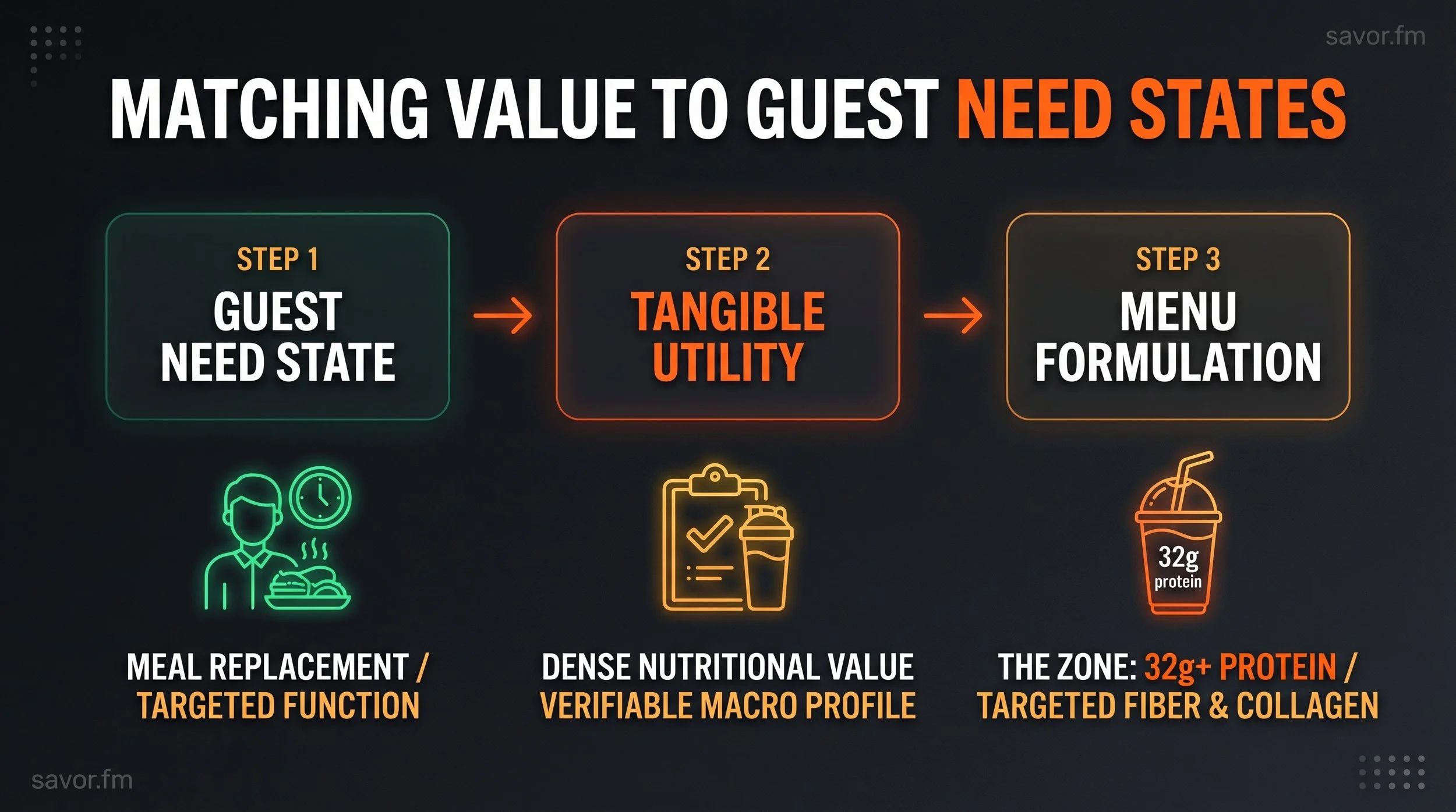
CEO Susan Taylor points out that guests willingly cross the $10 threshold when an item clearly functions as a meal replacement, backed by macro numbers that hold up to scrutiny:
High-protein anchors: The brand's original protein beverage, "The Zone," packs 32 to 35 grams of protein and accounts for roughly 10% of Q1 systemwide sales, maintaining a top-five rank for over 30 years.
Açaí bowls as core staples: Unit counts for the standard açaí bowl surpassed the legacy Strawberry Wave smoothie for the first time in brand history, providing high-margin, dense dinner options that now drive roughly 25% of overall business.
Purpose-built formulations: Rather than merely topping drinks with flavored foams, products are engineered alongside nutritionists to deliver verifiable doses of collagen, electrolytes, creatine, or targeted dietary fiber.
The 10-Store Test: How to Filter Fleeting Fads from Scalable LTOs
Menu creep is fatal to throughput and inventory control. Fast casuals frequently fall into the trap of chasing micro-trends seen across social platforms, only to burden franchise kitchens with single-use SKUs that stall on the line.
Juice It Up combats this by running an internal innovation pipeline guided by Director of R&D Noah Burgess:
Rigorous pilot testing: Potential products test in an isolated 10-store cohort (1 corporate store, 9 franchise locations) during the exact season targeted for rollout one year later.
Digital guest loops: Corporate tracks localized product mix (PMIX) data alongside targeted surveys sent through the loyalty engine directly to guests who purchased the test SKU.
Strict annual pruning: Systemwide PMIX is analyzed yearly. Only items with proven sales velocity and clean unit margins transition from limited-time offers to the permanent board.
LTO pipeline power: Roughly 40% of Juice It Up's current systemwide sales originate from LTO formulations developed over the last seven years—including permanent conversions and recurring seasonal staples like their horchata and lavender-berry profiles.
Scaled Expansion: Non-Traditional Footprints and Disciplined Growth
Ambitious growth plans often stumble when franchisors chase wide geographic spread at the expense of regional supply chains. Juice It Up targets a steady 10% annual net-unit expansion—roughly 10 to 15 stores a year—prioritizing contiguous infill over random pins on a map.
A key pillar of this strategy lies in non-traditional formats, expected to comprise 20% to 30% of future footprint development:
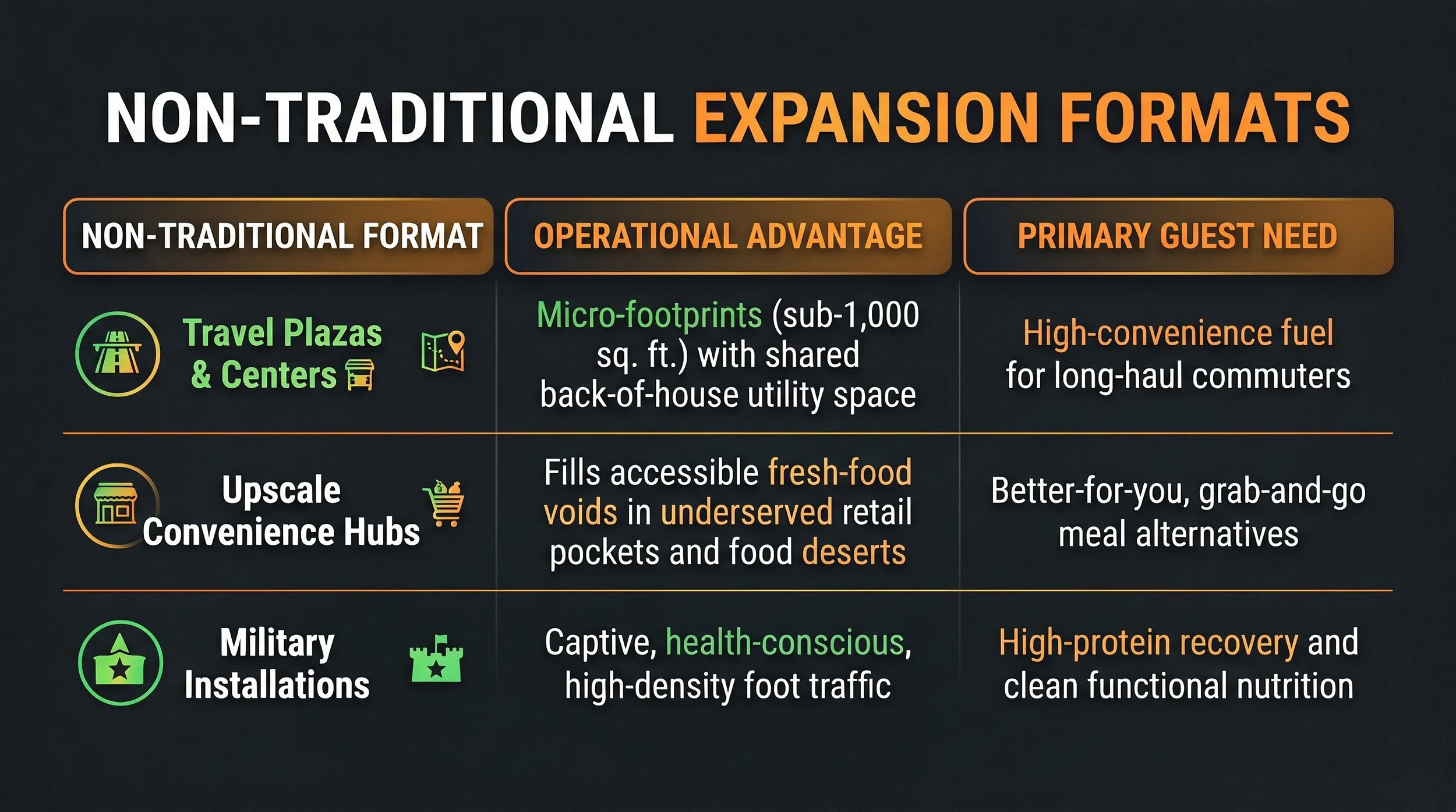
By matching lower capital requirements to high-density real estate, the brand creates favorable ROI profiles for franchise partners while introducing the brand to secondary markets ahead of traditional retail store builds.
Strategic Focus Over Shared Overhead
While multi-brand holding models frequently push shared administrative services as a magic bullet for margins, Juice It Up's ownership takes an intentionally restrained view.
Despite operating under the same parent ownership group as Mountain Mike’s Pizza, leadership avoids flattening functional teams across both businesses. Marketing, operational coaching, and culinary development remain strictly dedicated to each brand’s individual customer profile. Collaboration is confined to executive best-practice roundtables, preserving the distinct operations and guest relationships that keep specialized concepts competitive.
Key Takeaways for Operators
Protect your core before chasing add-ons. Functional boosts drive revenue only when built on a solid foundation of operational speed, taste, and everyday classics.
Treat LTOs as an empirical pipeline. Standardize an off-peak testing group, gather purchase feedback directly through digital loyalty channels, and let margin numbers—not hype—dictate permanent additions.
Explore unconventional real estate. Micro-footprints and non-traditional sites can accelerate brand discovery, cut overhead, and provide strong unit-level returns without cannibalizing existing trade areas.