
Three outside groups influenced your profit margins this week, and none of them asked for your input first:
The Federal Trade Commission (FTC) filed a federal lawsuit against Toast, one of the restaurant sector's most prominent POS platforms.
DoorDash agreed to acquire Instacart for $17 billion, creating a delivery and advertising powerhouse.
Voters headed to the polls to decide the future of the tip credit, tariffs, and immigration reform.
In this premiere episode of Restaurantomics—the macroeconomic-focused series from Modern Solutions for Modern Restaurants—host Paul Molinari breaks down what these headlines actually cost you, where the money moves, and the tactical steps operators need to take before the week is out.
The FTC vs. Toast: The High Cost of the "Subscription Trap"
On October 29, the FTC alongside eight state attorneys general (CA, CO, FL, IL, IA, NE, OK, UT) sued POS giant Toast in Northern California federal court, alleging hidden recurring fees, deceptive auto-renewals, and punitive early termination fees reaching as high as $5,000.
Toast is vigorously disputing the allegations, arguing that its restaurant accounts negotiate their contracts and that consumer-focused federal subscription statutes were never intended to govern business-to-business enterprise deals.
Regardless of which POS system powers your front-of-house, this lawsuit is a direct wake-up call to audit vendor contracts for quiet margin creep.
The Money Move: POS Contract Audit Checklist
Review your paperwork tonight: Pull your initial agreement and cross-reference your last three monthly processing statements.
Mark your renewal window: Identify your contract's auto-renewal date and set a calendar notification 90 days out.
Verify every line item: Ensure every monthly software and hardware charge corresponds to a feature your team actively utilizes. If you can’t verify it, flag and dispute it.
Audit processing fees: Check who retains your direct online ordering convenience charges. Trimming just $200–$300/month in idle add-ons recovers thousands of dollars annually—capital better deployed toward payroll and staff retention.

DoorDash Buys Instacart for $17B: Why Delivery Leverage Just Shrank
DoorDash’s $17 billion all-cash/stock agreement to acquire Instacart consolidates 600,000 personal shoppers, extensive grocery network integrations, and an ad ecosystem generating $331 million per quarter (~30% of Instacart's overall revenue).
While framed primarily as a retail grocery play, the implications for restaurant operators are massive. Instacart had been actively expanding into restaurant delivery partnerships; removing a major bidding rival consolidates marketplace leverage into fewer hands.
The Money Move: First-Party Channel Independence
Calculate actual net yield: Analyze delivery platform reports across every aggregator to calculate net profit per order after deducting base commission rates, platform promotions, and sponsored placement fees.
Require attribution for ad spend: If paying for in-app sponsored placement, demand verified conversion reporting before agreeing to renewal terms.
Treat 3rd-party apps as lead generation: Treat delivery apps strictly as top-of-funnel customer acquisition tools. Convert first-time third-party diners into direct, first-party regulars using email/SMS sign-ups, packaging inserts, and proprietary loyalty programs.
The Menu on the Ballot: Local Measures Over Federal Headwinds
While national elections dominate news cycles, state and municipal ballot measures dictate day-to-day profit and loss statements. Key legislative priorities from the National Restaurant Association and Independent Restaurant Coalition center on three fronts:
Preserving the statutory tip credit
Addressing immigration enforcement and workforce availability
Limiting interchange swipe fees and delivery aggregator fee caps
The Money Move: Grassroots Coalition Building
Model wage adjustments: Review sample ballots for local adjustments to minimum wage schedules, tipped wage credits, or municipal gross receipt taxes. Calculate the precise per-labor-hour cost impact on your prime margins.
Engage regional industry associations: Join and coordinate with your state restaurant association. Individual operator feedback is easily dismissed as an isolated complaint; a coordinated block of 50 operators represents an organized legislative constituency.
The Chili’s Playbook: Investing in Front-of-House Labor Productivity
While many casual-dining brands aggressively reduced front-of-house labor lines this year, Chili's leaned in the opposite direction—delivering 28% traffic growth over three years and 10% quarterly sales growth, with roughly two-thirds of that expansion driven by foot traffic rather than price hikes.
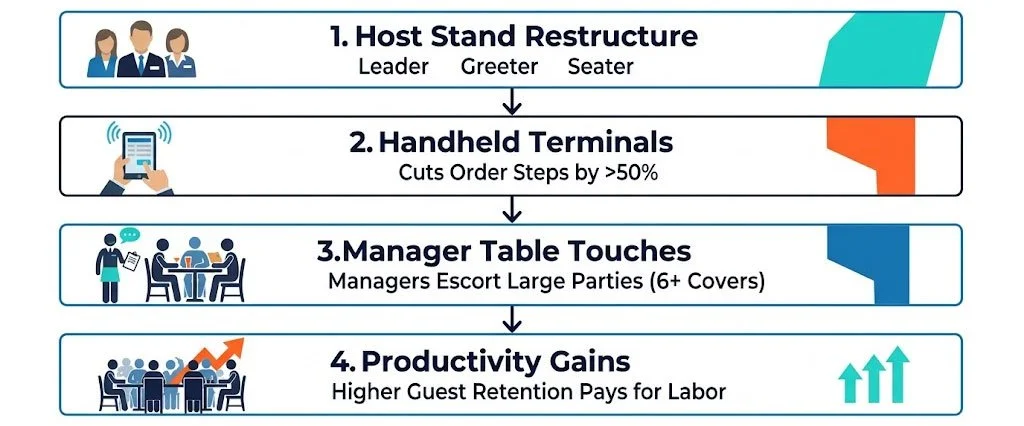
Chili’s restructured its operations based on its highest-performing units doing $6M+ in annual sales:
Retrained general managers on predictive schedule building.
Deconstructed host operations into three specialized roles: Leader, Greeter, and Seater.
Armed floor servers with handheld POS tablets, eliminating half of order-entry touchpoints.
Deployed managers to personally greet and seat parties of six or larger.
The Money Move: Strategic Peak-Hour Staffing
Examine cover-to-labor discrepancies: Review your POS reporting to identify your three peak volume hours of the week. Look for historical shifts where trimming two labor hours caused bottled door queues and lost a full table turn.
Prioritize the front door: Place your most skilled, hospitable team member at the host stand during Friday and Saturday rushes, and mandate that floor managers personally touch every high-top and large party.
Gen Z Research Hit: What Is Restaurant Merch Actually Worth?
Closing out the show, research analyst Jason Molinari analyzed 7,720 completed eBay sales across 22 national and regional restaurant brands (ranging from McDonald's to Waffle House):
Baseline logo value: A standard restaurant logo on resale apparel commands a modest average of $19.
National chains vs. regional brands: Brand scale did not dictate pricing; volume sellers and cult brands traded at near-identical baseline prices.
The driver of margin: Scarcity and vintage era dictate actual margin. A current standard-issue uniform shirt fetched $8.99, while a 1980s In-N-Out varsity jacket commanded $349—a 39x price spread.
Takeaway: Move away from stocking evergreen branded t-shirts. If offering restaurant merchandise, treat production runs as limited-edition seasonal "drops" tied to brand milestones, distinct creative collaborations, or specific operating years.
Subscribe to the Restaurantomics weekly newsletter at popcorngtm.com/restaurantomics for regular economic teardowns. For restaurant technology providers seeking to refine their market strategy, connect with Paul Molinari's team at popcorngtm.com.