
We scored 19 operators and 10 kinds of AI on one question: will it move sales, margin, labor or guest satisfaction? The answer usually isn't the robot.
The bottom line: The operators getting real value from AI in 2026 put it where guests don't have to change anything: the back office, the phone line, the hotel revenue desk and the prep schedule. The drive-thru is the most visible bet. It works with a crew member backing it up and a control group to measure it, and it fails when it's sold as a labor cut. Hotels are ahead of restaurants because Hyatt, Hilton and Accor started with sales and guest messages. Question everything: almost every result below is company- or vendor-reported, and ordering through AI agents is still a rounding error.
Lots of AI, very little proof
The industry is using AI. It isn't running on it. In the National Restaurant Association's latest technology survey, 38.6% of operators said they use AI tools, but only 3.2% run AI companywide and 20% are still piloting.
Guests aren't sold either. Technomic data cited by Nation's Restaurant News shows only 23% of consumers find ordering from an AI drive-thru bot appealing, while 46% find it unappealing. And the much-hyped AI shopping agent barely shows up yet: Uber said about 500 orders in a week came from AI agents, against roughly 320 million trips, per NRN.
So we stopped asking who is "doing AI" and asked who can show it's working.
How the Savor AI Score works (opinion)
The Savor AI Score is our editorial judgment, from 0 to 10, of how likely a deployment is to make a meaningful difference to the business: sales, margin, labor or guest satisfaction. Ten is the highest likelihood. It's built only on public evidence linked in this story. We weigh how far a deployment has scaled, whether results are measured against a control group or simply claimed, how much it asks of guests and crews, how ready the underlying data is, regulatory risk, and whether it's scaled, piloting or pulled back.
It's opinion, not a measured statistic. Operators are scored; technology vendors are named only as deployment partners and aren't ranked.
The operator rankings
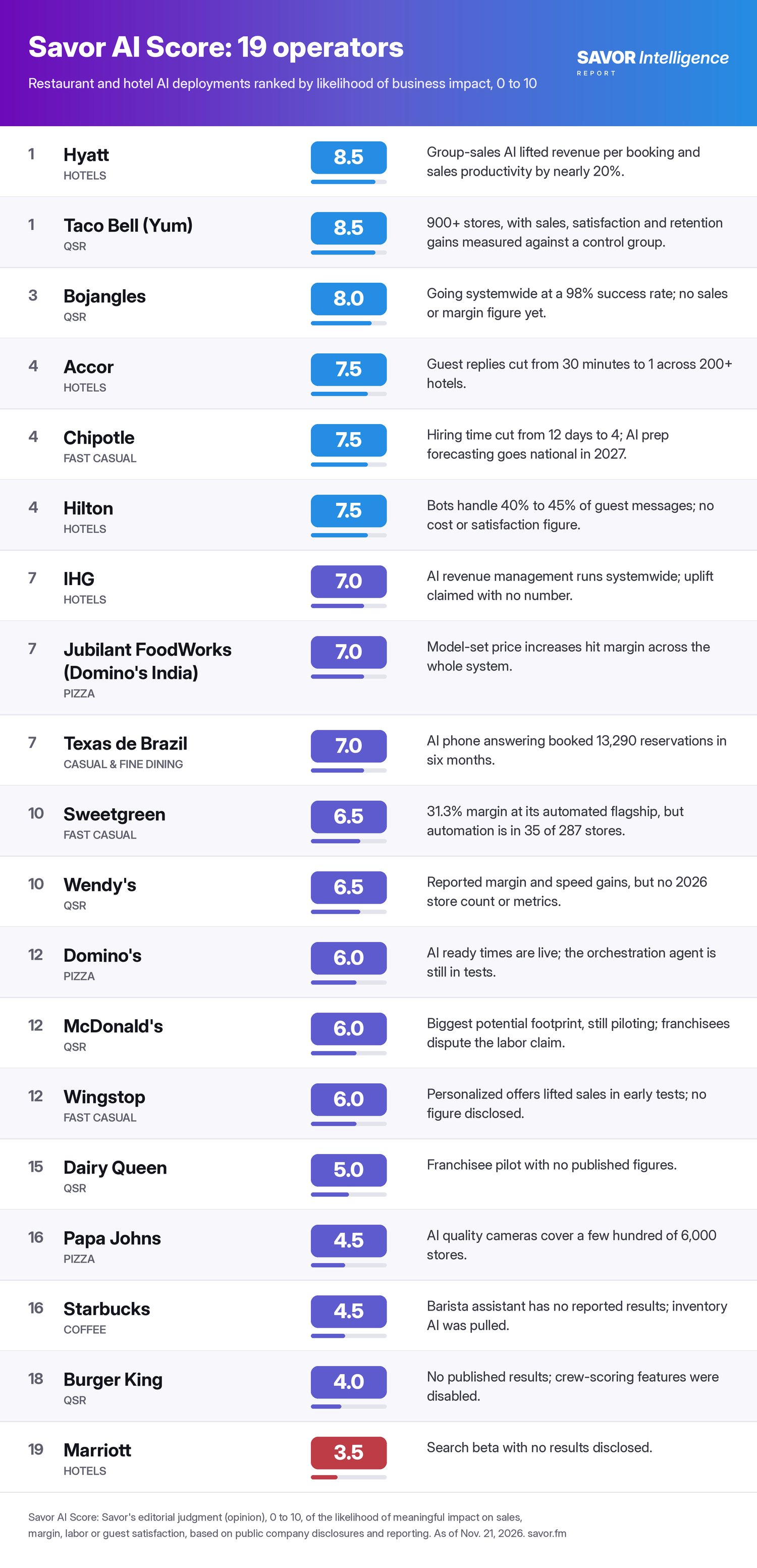
The top of the board
- Hyatt, 8.5. Its agentic group-sales platform ranks every RFP that comes in. Hyatt says it grew group share, raised revenue per group booking and improved sales-team productivity by nearly 20%, per Business Travel News, and freed about a full day a week per salesperson. AI-drafted conversion improvement plans now take a day instead of weeks, per Hotel Management.
- Taco Bell, 8.5. More than 900 restaurants use drive-thru voice AI, with more than 1,500 targeted by year-end. Against a control group, Yum reported a 6% improvement in drive-thru satisfaction, about a 1.5% sales uplift from higher checks and better crew retention, on its third-quarter call. That's the gold standard for disclosure in this category, but it's self-reported, and the control group's size wasn't disclosed.
- Bojangles, 8.0. Its Bo-Linda voice system with partner Hi Auto is in nearly 500 restaurants and is extending to the full 890-plus system. The companies say it handles more than 1 million orders a week at a 98% success rate and connects directly to the POS, per NRN.
- Accor, 7.5. Its guest-relations AI platform, in more than 200 hotels, cut reply times from 30 minutes to one and saves up to 100 hours per hotel a month, an Accor executive told Skift. Its AccorGPT staff tool saves an average of 2.5 hours a week across 7,000 users, per Accor.
- Chipotle, 7.5. The Ava Cado hiring agent cut time from application to start from 12 days to four and raised application completion from 50% to 85%, according to a Workday Paradox case study. Its Cook to Needs AI prep tool is in more than 500 restaurants and goes national in early 2027, per its third-quarter call.
- Hilton, 7.5. Messaging bots handle roughly 40% to 45% of incoming guest messages, its CIO said, per HOTELS. Hilton gives no cost or satisfaction figure.
The middle
- IHG, 7.0. It credits its AI-enhanced revenue management system with "revenue uplift and market share gains" for owners, per its half-year call, but puts no number on it. Conversational search is in a U.S. beta.
- Jubilant FoodWorks (Domino's India), 7.0. It took price increases "very calibrated through machine learning models" by daypart and channel, per CIO Monitor. Pricing hits margin directly.
- Texas de Brazil, 7.0. AI phone answering with partner Slang AI handled 269,447 calls and booked 13,290 reservations in six months across its U.S. locations, with 96% caller satisfaction, per a vendor case study.
- Sweetgreen, 6.5. Its Naperville Infinite Kitchen posted a 31.3% restaurant-level margin in its first year, but automated units were 35 of 287 restaurants by mid-2026, per Franchise Times. It also just launched ordering inside ChatGPT and Claude, with no results yet.
- Wendy's, 6.5. FreshAI, built with Google Cloud, was processing tens of thousands of orders a day in 2025, and Franchise Times cites a company-reported margin bump of about 8% and 22 seconds off service time. But the third-quarter release gave no FreshAI figures. Silence costs points.
- Domino's, 6.0. AI now sets order ready times in its tracker, and an orchestration agent that holds orders until a driver is back is still in store tests, per its first-quarter call. No return disclosed.
- McDonald's, 6.0. It expects its Archy smart ordering system in a majority of U.S. restaurants by the end of 2027, per its third-quarter call. The company claims more than 90% accuracy and at least 50 labor hours a week freed, but franchisees, via BTIG, called that labor number "highly theoretical," per Restaurant Dive.
- Wingstop, 6.0. Guests who got offers from its new AI personalization engine generated higher total sales than those who didn't, per its third-quarter call. No figure was given.
The bottom of the board
- Dairy Queen, 5.0. It is expanding its voice AI pilot with partner Presto to at least 25 franchisees, aiming eventually at nearly all 3,000 U.S. and Canadian drive-thrus, but Presto declined to share performance figures, per Restaurant Dive.
- Papa Johns, 4.5. AI quality cameras are in only a few hundred of its 6,000 restaurants, and checking customer photos isn't yet as accurate, per Reuters.
- Starbucks, 4.5. Its Green Dot Assist barista tool went from a 35-store pilot to all North American stores, per GeekWire, with no tool-level results reported. Its AI inventory counting was dropped after nine months, per Supply Chain Dive.
- Burger King, 4.0. Its Patty headset assistant was piloting in about 500 restaurants, with all U.S. stores planned by year-end, per NRN. Features that scored crew members on friendliness and upselling were disabled after a Capital & Main investigation.
- Marriott, 3.5. Ask Bonvoy conversational search is in beta, and the CEO says AI's impact so far is mainly in trip discovery, per Hotel Dive. No results disclosed.
The deployment rankings
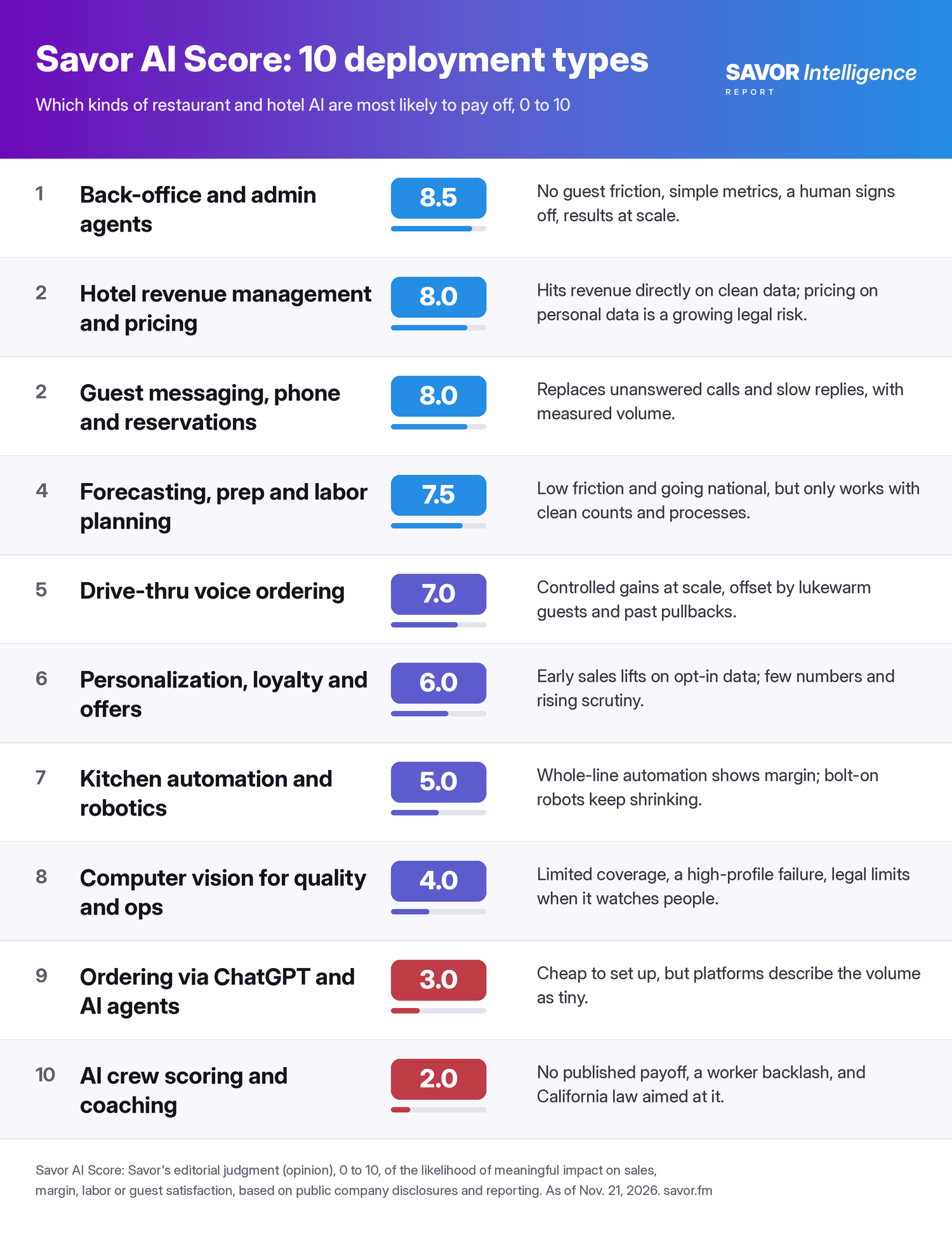
1. Back-office and admin agents: 8.5. Guests never see it, the metric is simple and a person signs off. Chipotle's hiring time and Hyatt's sales productivity above are the proof. The catch: hours saved aren't profit until the time goes somewhere.
2. Hotel revenue management and pricing: 8.0. Hotels have priced by demand for decades, and the data is clean. Where it gets risky is pricing on personal data. New York City's Council just passed a bill banning surveillance pricing, and the FTC is studying personalized pricing.
2. Guest messaging, phone and reservations: 8.0. It replaces an unanswered call or a slow reply, not a conversation with a person. Hilton, Accor and Texas de Brazil all show volume. It fails when there's no fast handoff to a human.
4. Forecasting, prep and labor planning: 7.5. It cuts waste without touching the guest, but only on clean data. Starbucks fixed its stockouts with one standard process and daily deliveries, not cameras.
5. Drive-thru voice ordering: 7.0. Taco Bell and Bojangles prove it can work at scale. But guests are lukewarm, and NRN reports Burger King is slowing its voice test after finding some customers don't like it. What decides it is POS integration and how fast a crew member can step in.
6. Personalization, loyalty and offers: 6.0. It runs on data guests opted into, and Wingstop shows early lifts. When it feels like surveillance, it backfires: Starbucks' idea of recognizing guests on arrival drew a heavy backlash. Personalize the offer, not the menu price.
7. Kitchen automation and robotics: 5.0. Rebuild the whole line, like Sweetgreen, and the margin shows up. Bolt on one robot and it mostly doesn't.
8. Computer vision for quality and operations: 4.0. Pointed at the pizza, it helps. Pointed at inventory, it failed at Starbucks. Pointed at people, it runs into California law.
9. Ordering through ChatGPT, Claude and other AI agents: 3.0. It's cheap to set up, but Hilton's CEO calls agent bookings "insignificant" today, per Hilton's third-quarter call, and Hyatt calls them "very, very small." Make the menu machine-readable. Don't budget for the volume yet.
10. AI crew scoring and coaching: 2.0. No published payoff, a worker backlash, and a law aimed squarely at it. California's newly signed SB 947 bars employers from relying only on AI to discipline or fire workers. Coach the shift, not the person.
The cautionary cases
- McDonald's and IBM (2024). McDonald's ended its automated order-taking test at more than 100 drive-thrus. Accuracy comes before scale.
- Del Taco and Presto (2023 to 2024). Del Taco canceled its test, and Presto's own filing said its most advanced voice product needed human intervention at least 70% of the time, per Restaurant Dive. Ask what share of orders is really automated.
- Starbucks inventory AI (2025 to 2026). Dropped after nine months as unreliable. Fix the process before you buy the AI.
- Burger King crew scoring (2026). Workers told Capital & Main that low scorers lost shifts, and the scoring features have since been disabled. Don't grade people with a tool sold as help.
- Miso Robotics' Flippy (2022 to 2025). White Castle announced 100 locations in 2022. By the end of 2025 the installed fleet had shrunk to about 14 robots, at an estimated $5,000 a month, per Franchise Times.
- Taco Bell's stumble (2025). It slowed its rollout after an ordering glitch went viral, per NRN, and coached crews to step in earlier. Now it's scaling again with control-group results. A stumble isn't fatal if you measure.
What the winners do differently
- One job, one number, one control group. Taco Bell reported satisfaction, check and retention against a control group. Franchisees should fund that kind of disclosure.
- A human backs it up by design. Bojangles pairs every order with an image of the car so staff can verify it. Hilton's bots pass what they can't handle to staff, and Accor's tools draft replies that people send.
- The plumbing comes first. Bojangles connected voice straight to the POS. Sweetgreen made every ingredient and price machine-readable by restaurant.
- Aim it at tasks, not people. The tools that scale take work off the crew's plate. The tools under fire grade the crew.
- Rebuild the whole line or don't automate. One robot at one station rarely pays for itself.
- Revenue first, savings second. Hyatt says its AI work puts revenue first, with cost savings and productivity after, and its group-sales results show it.
Savor's 2027 calls (opinion)
These are my forecasts, not reported facts. Question everything, including us.
- Voice AI becomes standard at the biggest drive-thrus, and the scorecard moves from labor hours to guest satisfaction and crew retention. McDonald's 50-labor-hour claim will be the number franchisees test hardest.
- The quiet winners are the back office and hotel commercial teams. Group sales, revenue management and guest messaging don't ask guests to adapt to anything.
- AI-agent ordering won't move 2027 sales, but it will start deciding who gets recommended. Brands with accurate, machine-readable menus, prices and allergens will show up in AI answers more often.
- Regulation shapes the product. Crew-scoring dashboards come out of California stores, and personalized deals stay inside opt-in loyalty programs, while menu prices stay the same for everyone in places like New York City.
- Bolt-on kitchen robots keep losing ground. Whole-line automation shows up mostly in new builds for brands with a high digital mix.
The question to ask any AI pitch, from a vendor or your own team, is simple: compared with what? If there's no control group, there's no score.
Want restaurant and hospitality intelligence in your inbox? Get Savor Insider free.
Art: Generated by Savor AI.