
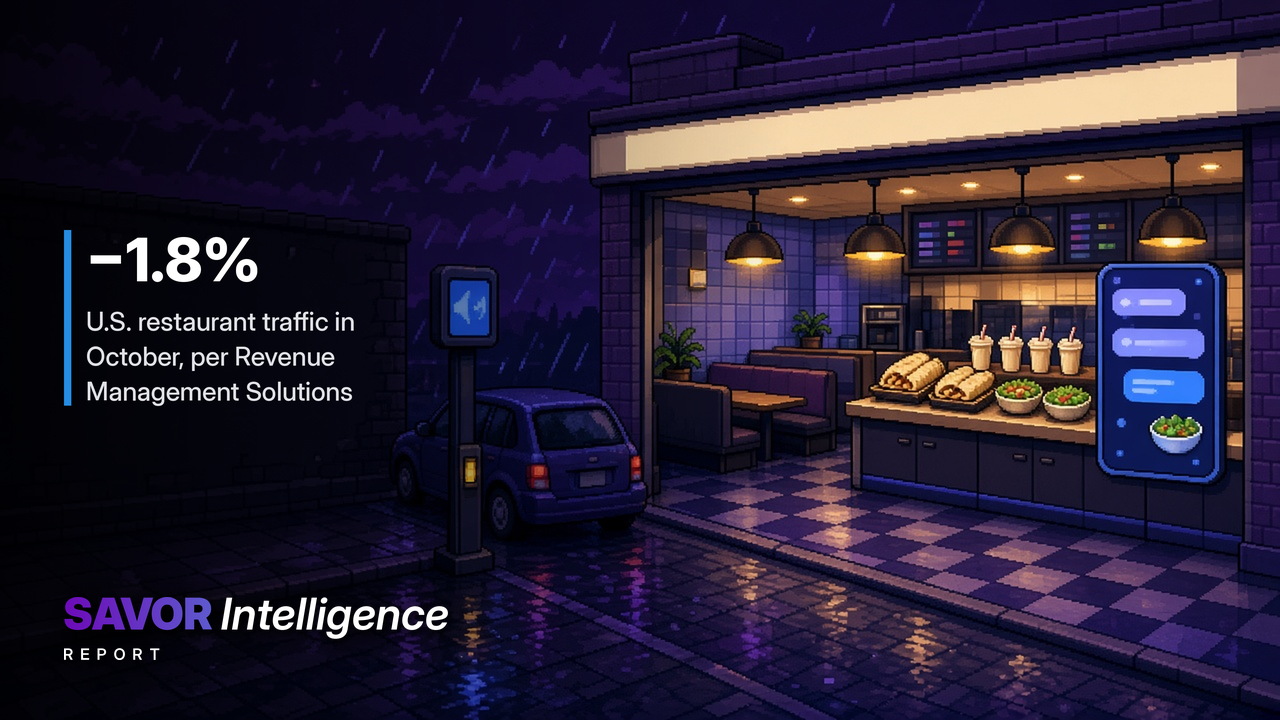
Restaurant traffic fell 1.8% in October, and nobody expects 2027 to be better. The chains still growing are rebuilding the line, the value offer and the menu itself to win a smaller pool of visits.
The bottom line
Stop planning for traffic to come back. The brands posting gains are getting faster at peak, adding an occasion, testing value on their best guests first, and turning the menu into data that AI assistants and drive-thru bots can read. Discounts buy visits. Systems keep them.
1. A shrinking pool means every visit costs more
Revenue Management Solutions says restaurant traffic fell 1.8% in October and has been positive year over year in only three months since January 2025. Bloomberg Intelligence's Michael Halen told the same Restaurant Finance and Development Conference panel: "Don't expect 2027 to be any different."
RMS's Jana Zschieschang put the split plainly: one in two restaurants is losing sales to lower traffic, and one in five is still growing. The growers favor everyday value over temporary discounts and aim any discount at a specific audience.
Tropical Smoothie Cafe rebuilt its cafés so food moves one way, line to ovens to expo, with a dedicated station for each person. Peak-time speed is now 40% faster. Its 13 million loyalty members visit three times as often as non-members. Speed and frequency are the levers you control. Traffic isn't.
2. Add an occasion, then test value where it can't leak
Smoothie King's same-store sales rose 8.7% in the third quarter with positive traffic, up from 5.9% in Q2. Comps hit 11.6% in August after Chicken Flatbreads launched, and guests are bundling them with a drink. A beverage brand added a meal.
Kura Sushi is doing the opposite math. Its average check reached $29 and fourth-quarter traffic fell 11.5%, mostly at weekday lunch. So it tested $9.99 and $11.99 lunch combos, promoted only to rewards members. They made up 5% of orders in the three-day test, and average spend per guest didn't drop. Kura is expanding toward a national rollout and let a 3.5% price increase roll off without replacing it. That's how you test a value tier: on your own guests, before the public sees it.
Holiday offers follow the rule. Jason's Deli will sell a $5 birthday menu on Nov. 30 across 236 units, dine-in only, one per guest. El Pollo Loco is selling wrapping paper with coupons printed on the back, redeemable by Loco Rewards members from Dec. 1. Deep deals, with a condition: come in, or sign in.
3. Off-premise works when you don't mark it up
Cheesecake Factory says delivery and pickup are now about 21% of revenue and growing about 15% a year, alongside 15.2% same-store sales growth last quarter. CFO Matt Clark said the chain takes "a couple percent of pricing" on DoorDash versus its dining-room menu, well under peers who mark up heavily to cover commissions. DoorDash, its exclusive partner for nearly 10 years, doesn't stack other stops on Cheesecake orders.
The lesson isn't "go all in on delivery." A big delivery markup is a hidden price increase, and guests notice. Cheesecake negotiated service standards and kept prices close to the dining room. Most operators did the opposite.
4. The menu is now a data feed, and pilots are being judged
Sweetgreen now takes orders through ChatGPT and Claude. Guests ask for a protein target or an allergen-free lunch, build the bag in the chat, then check out in Sweetgreen's own app or website, where rewards and saved payments live. The enabler: a machine-readable menu with every ingredient, allergen and price accurate to the restaurant. The AI gets the discovery. Sweetgreen keeps the transaction, the loyalty data and the guest.
Checkers & Rally's shows what "pilot to standard" looks like. It extended its Hi Auto drive-thru AI contract through 2030. The system runs at 267 stores, adds about 100 more by the end of the first quarter, has taken more than 11 million orders this year, raised average ticket 1.1% and cut orders needing a crew member to step in by 50%. Bring those numbers to your own vendor negotiation.
And not every pilot survives. Starbucks dropped a computer-vision AI inventory pilot after nine months because employees found it unreliable. A single standard process and daily deliveries, now at nearly 90% of company-run North American stores, fixed stockouts instead. Judge AI by what it changes in the store, not by the demo.
5. Costs won't bail anyone out
Cal Poly's Ricky Volpe expects grocery prices to rise faster than usual into early 2027 on diesel and a strong El Niño, with palm oil, rice, cocoa and coffee most exposed; grocery rose 0.4% in October, the fastest since April. That flatters eating out, but it also hits your fryer oil and coffee. Beef packer margins averaged $86.42 a head last week versus a $40.12 loss a year ago, so don't expect wholesale beef relief. And Hormel closed its roughly $1.055 billion Brakebush deal, which it expects to triple its net chicken sales. If breaded chicken is on your spec sheet, your supplier just got bigger.
Savor Brand Price Watch (members only)
Savor Intelligence tracks pricing and promotion moves across 600 restaurant brands. This week the Savor Intel model surfaced a quieter value play: shipped gifts priced around a threshold, not a discount.
1. Free-shipping lines set the basket. Mrs. Fields offers free standard shipping on orders of $75 or more. Gibson's Steakhouse offers free shipping on Steak Shop orders over $175 with holiday gift boxes on pre-order sale. Fiorella's Jack Stack Barbecue ships free every day on orders of $199 or more, pitched as "Barbecue at Every Price Point." The threshold is the real price signal: it tells the guest how much to spend to make the deal work.
2. The $50 gift is the anchor. Mrs. Fields' holiday Nibblers cookie tins (36 count) are $50 each. Summer Moon Coffee's Christmas Favorites and Christmas Fireside trios are $50 each, against a stated $57.85 value, about 14% off. One round number, built for gift lists.
3. Small discounts tied to repeat orders. Philz Coffee is offering 10% off its coffee bags with a push toward subscription. The discount is small; the subscription is the point.
What it means: in a down-traffic year, the shipped menu is revenue that doesn't need a seat, priced to a threshold and a round gift number, not a markdown.
What to watch
Kura's national value rollout (Dec. 1 to Feb. 28): does average spend per guest hold once the combos go public?
Sweetgreen's AI orders: whether it shares conversion or new-guest data, and which chain opens its menu to AI assistants next.
Checkers' AI count: does it reach about 370 drive-thrus by the end of Q1, and do labor hours per order fall?
Jason's Deli on Nov. 30: a clean test of what a one-day $5 price point does to traffic.
Closing
Fewer guests is the 2027 plan, not a bad quarter. Speed up the line, add a new occasion, test value on your members first, and make your menu readable by whatever the guest uses to order. That's how chains are growing in a down market.