
Google gave restaurants a kill switch for delivery links, Olo proved price parity isn't enough, and Applebee's showed what loyalty data costs when it leaks. The fight for the guest just got very specific.
The bottom line
For five years the delivery marketplaces owned the moment a hungry guest decides where to order. This week that moment cracked open. Restaurants can now choose which ordering links sit on their own Google listing, and the economics of steering guests to first-party channels are sharper than ever. But owning the guest comes with a bill: the app, the login, the birthday on file and the security to protect all of it. The Savor Intel model reads this as the start of the direct-ordering era's second phase, where control is cheap to claim and expensive to keep.
Google just gave you the switch
Google now lets restaurants disable individual ordering providers, including Uber Eats, DoorDash, Grubhub and Instacart, or limit them to pickup or delivery, right from the Business Profile dashboard. For most operators, Google Search and Maps are the front door. Until now, that front door often showed a marketplace link sitting right next to your own "Order" button, and the marketplace frequently won the click.
This is the cheapest direct-ordering move of the year. It costs nothing, takes ten minutes and changes where your highest-intent traffic lands. Google itself suggests keeping "a mix of trusted providers," and that's fair. Marketplaces still bring you guests who have never heard of you. The point is that the choice is yours now. Make it on purpose.
Price parity is not the win you think it is
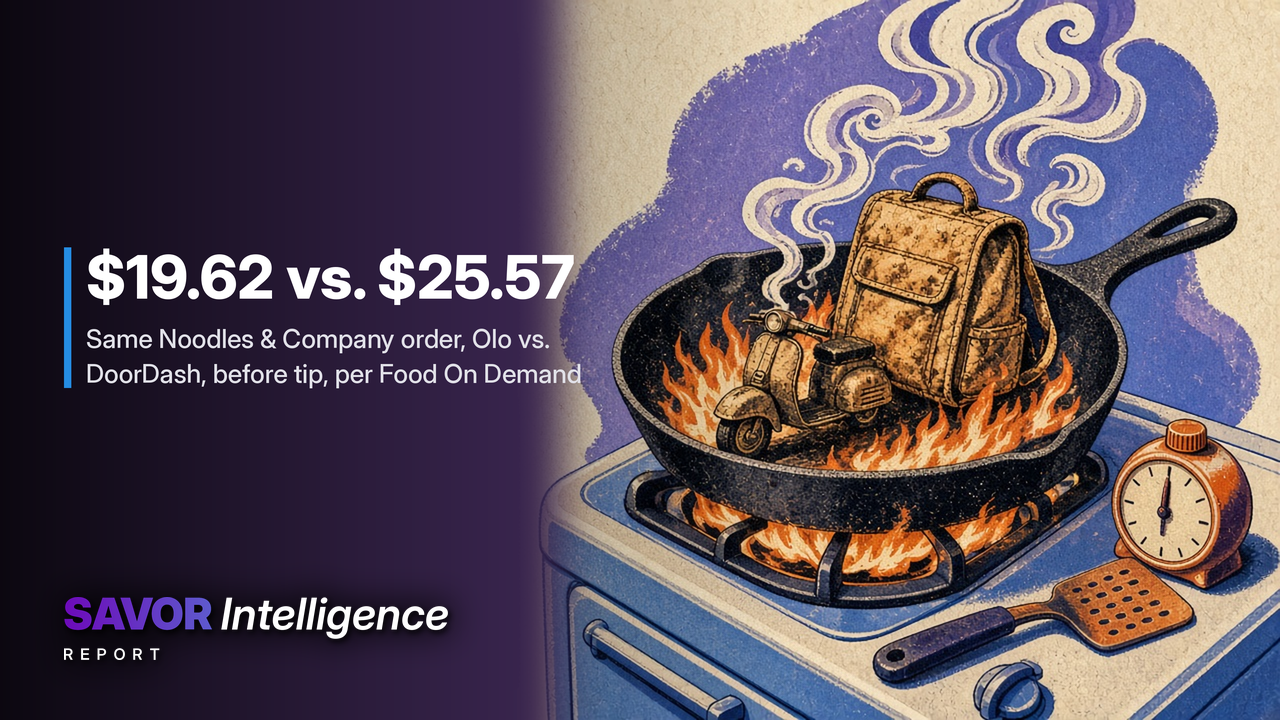
Olo launched its own consumer marketplace on Oct. 20 with a simple pitch: in-store menu prices plus a 5% network fee. Olo CEO Noah Glass says menu prices on the commission apps "often run 15 percent to 30 percent higher than in-store." Food On Demand put it to the test in four markets. Olo had the lowest food subtotal every time, but the lowest final bill only twice.
In Minneapolis, the same Noodles & Company order came to $19.62 on Olo and $25.57 on DoorDash before tip. In New York, Grubhub's automatic fee waiver on a $50-plus Bonchon order pulled it to within two cents of Olo. Near Houston and in Sacramento, Olo's delivery fees ($6.50 and $7.74) erased its head start entirely.
The lesson for operators: guests compare the finished basket, not the menu price. If you're steering people to your own channel, the delivery fee and the promo at checkout are what close the sale. The marketplaces know this. Their automatic discounts are a weapon, and your first-party channel needs one too.
The platforms aren't standing still
DoorDash's third quarter showed Marketplace GOV of $33.9 billion, up 36%, with U.S. restaurant growth accelerating slightly. DashPass growth has cut transaction fees per order 9% over two years, which is exactly the fee gap that sank Olo in two of those four tests. And DoorDash is coming for the reservation book: reservations on the platform grew more than 340% quarter over quarter.
What isn't happening yet is the AI-agent ordering wave. Tony Xu said third-party agents have sent DoorDash "maybe several hundred orders in total." Where AI is getting real traction is the phone and the text thread. Hostie raised a $12 million Series A for its AI host, which says it has booked more than 400,000 covers and is adding direct takeout ordering. That's tech moving from pilot to standard practice, and it puts the AI host in direct competition with your online-ordering vendor. If a vendor pitches you an "AI agent channel" as a revenue line today, ask to see the orders.
Your loyalty data is a liability, too
Every first-party channel runs on data: logins, birthdays, ZIP codes, order history. This week showed the downside. A researcher used AI to find a hardcoded database password in Applebee's Android app that exposed names, emails, birth dates, phone numbers, ZIP codes and veteran status. Dine Brands says it has found no evidence of unauthorized access. Applebee's had at least 8.5 million rewards members as of last year, and Dine had no channel for researchers to report the bug.
Then there's the trust line. Starbucks says it will explore drive-thru experiences that "recognize participating customers as they arrive" and show personalized menus. The reaction on X was heavily negative, with many posts calling it surveillance. Personalization the guest asked for feels like service. Personalization they didn't ask for feels like a camera.
If you're going to collect a guest's birthday for a free dessert, protect it like a card number.
Savor Brand Price Watch
Members only. Savor Intelligence tracks pricing and promotion moves across 600 restaurant brands. This week the Savor Intel model surfaced a clear pattern: brands are paying real money to pull orders out of the marketplaces and into their own channels.
First-party-only discounts are the norm. Shake Shack is offering $5 off $15 and 20% off a first Shack App order, excluding third-party delivery. Mixt is running 25% off its new Asado bowl through its rewards account, valid on its own delivery but not third-party. Papa Gino's ran 30% off pizzas ordered online, and Zachary's Chicago Pizza offers 15% off on VIP Mondays; both exclude third-party delivery.
Brands are subsidizing their own delivery. Tijuana Flats is offering free delivery on in-app and web orders of $35 or more through Nov. 2, a direct answer to the fee gap that Olo couldn't close.
Pickup is getting paid for. North Italia's welcome offer is $10 off a $20-plus pickup order on its own ordering site. That's a casual-dining brand buying the first direct transaction.
Memberships and loyalty launches. Urban Plates' Plate Pass promises 20% off every order. Original Tommy's launched Tommy's Rewards with a free chili cheeseburger for new members, and Summer Moon Coffee is giving new app users 75 bonus points ahead of its Nov. 6 holiday menu.
The value floor holds. Original Tommy's ran $4.49 and then $4.99 no-limit burger and chili deals, and Tijuana Flats' Taco Tuesdaze bundle (two tacos, chips and a drink) is $7.99 in-store, in-app and online but not on third-party apps.
The takeaway: nearly every deal asks for a download, a login or a signup. Operators are buying the guest relationship one discount at a time, which makes the Applebee's lesson about protecting that data more urgent, not less.
What to watch
Google profile adoption: Watch which major chains switch off or limit marketplace links first, and whether the marketplaces respond with richer promos on Google itself.
Olo's fee structure: If Olo moves on delivery fees, it closes the gap that cost it two of four head-to-head tests.
Yum Brands earnings, Tuesday, Nov. 3: A read on KFC's redesign and digital push, including how much of the business is running through owned channels.
App security disclosures: After Applebee's, expect more researchers to test restaurant apps with AI tools. Chains without a bug-reporting channel are exposed.
Opt-in recognition: How Starbucks frames its drive-thru recognition test will set the template, or the warning, for everyone else.
Closing
The order button used to belong to whoever paid the most for the click. Now it belongs to whoever sets it up, prices the full basket right and earns enough trust to keep the login. Flip the switch on your Google profile this week. Then make sure your own channel is worth the trip, and that the data it collects is locked down.
Paul Barron, Savor Intelligence